Disney Patent Could Make Ride Vehicles More Accessible for Wheelchair and Scooter Users

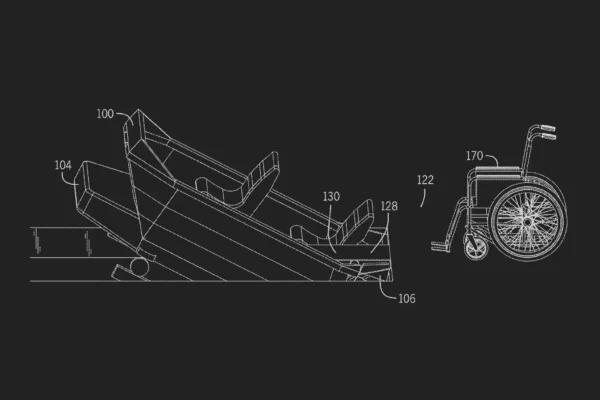
Disney has filed a patent for a ride vehicle that could allow guests to remain in their wheelchairs or scooters while boarding. Although the patent focuses heavily on boat rides, Disney says the system could also be adapted for other types of attraction vehicles.
Thanks to Aahs n Oohs for sharing the filing with us.
We’re really intrigued by the possibilities. For many guests, transferring from a wheelchair into a ride vehicle is difficult. For others, it’s impossible. That’s what makes this patent so encouraging. Disney isn’t simply trying to make boarding more convenient. It’s designing a vehicle around guests who might otherwise not be able to ride.
How Disney’s accessible ride vehicle works
The patent is titled “Rider Inclusive Transport Aide” and describes a boat containing a movable platform for a wheelchair, scooter, or other mobility device. At the loading station, the entire boat tilts. As it does, the platform rolls toward the loading area along a curved track, staying level throughout the process. This allows guests in mobility devices to roll or drive onto the platform and into the vehicle.


After the wheelchair or scooter is secured, the boat returns to its normal position. The platform moves farther inside and down into the hull, placing the guest level with the boat’s regular seats.
The easiest way to picture this is that Disney tilts the boat while keeping the wheelchair platform level. The boat essentially moves around the guest.

Why accessible boat rides are difficult to design
Boat rides present some obvious accessibility challenges. Their gunwales, or sides, need to remain high enough to keep water out, making it difficult for a wheelchair to enter the vehicle.
Cutting a door into the side of the boat creates possible leak points. A ramp needs to be long enough to maintain a manageable slope, requiring significantly more space in the loading station.
Under ADA standards, ramp runs generally can’t be steeper than 1:12. That means for each inch of vertical rise, you need 12 inches of horizontal run. A one-foot change in elevation would therefore require 12 feet of ramp.
Powered lifts come with their own problems. As Disney notes in the filing, most boat rides don’t have onboard power for those mechanisms.
Reliability is also an accessibility issue
In the filing, Disney discusses the complexity, maintenance demands, and downtime associated with existing accessible loading systems. When specialized loading equipment goes down, the guests who need it may be the only ones told they can’t ride.
That’s hardly accessible.
By using gravity to move the platform, the system could require fewer onboard motors and powered components. That could make it more reliable and easier to incorporate into a ride vehicle without dramatically increasing its size and weight.
There is a meaningful difference between accommodating someone and actually designing the experience to include them. This patent is aiming for the latter. Remaining in a wheelchair can preserve a guest’s comfort, safety, and dignity. It also eliminates a transfer that may require physical assistance or carry a risk of injury.
Mariann Bell, a staunch supporter of accessibility in theme parks, is thrilled with the possibilities:
“This is a wonderful innovation that could make enjoying the theme parks so much easier for families with wheelchair users in their party! It could also reduce wait times, because transferring does take time.”
This is only a patent filing
As always, a patent filing doesn’t mean Disney is preparing to use this system in an attraction. It also doesn’t tell us which wheelchairs or scooters would be accommodated or what happens during ride evacuations.
But it does tell us that Disney is devoting time and resources to solving this problem. I hope Disney finds a practical use for it. Allowing families to experience attractions together, without requiring some guests to leave their mobility devices behind, is what it’s all about.
Visit our patent hub for more greatness that may – or may not – be coming to Disney and Universal theme parks.